
Workflows Overview
How agents put Structured Agent Knowledge to work in practice. Every workflow in this section sits on top of the same loop and the same graph.
The Core Agent Loop
Every LocusGraph-powered agent follows the same loop:
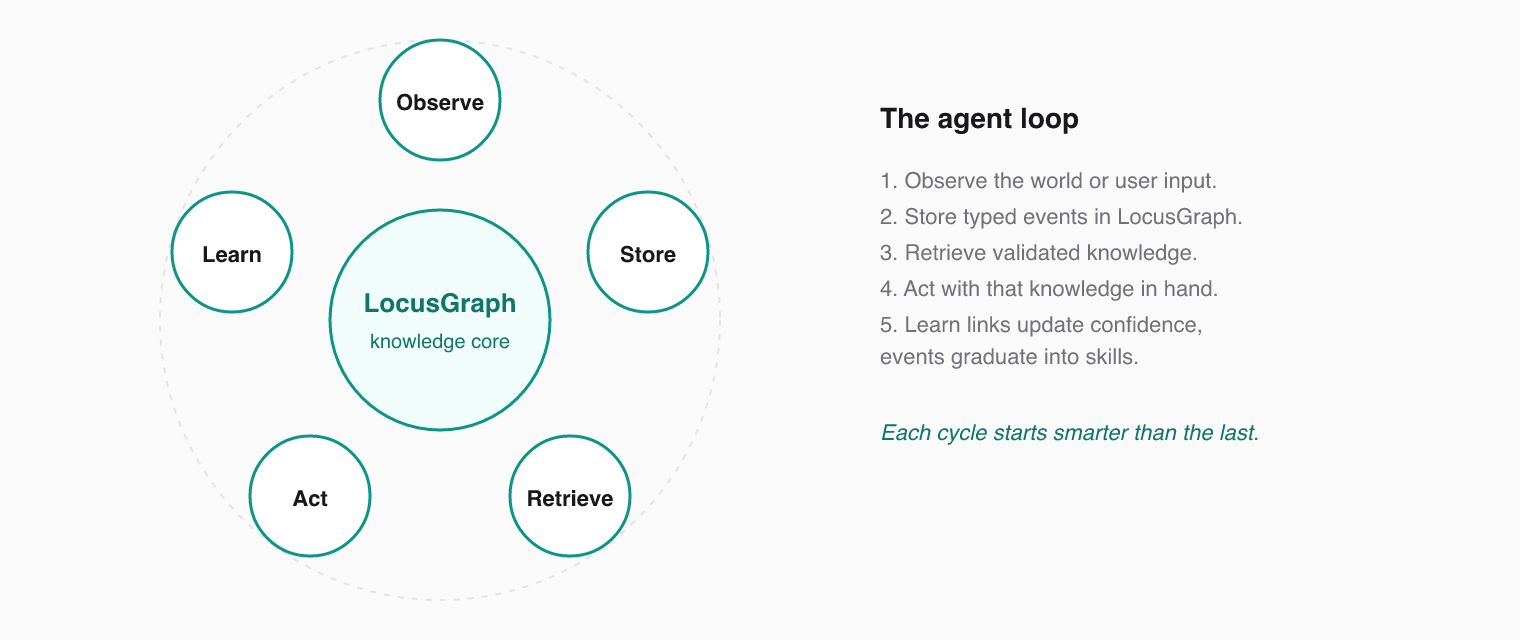
This loop runs every session. Over time, knowledge compounds — each session starts smarter than the last because events graduate into patterns and patterns graduate into skills.
How Sessions Work
Every session starts by retrieving relevant context. The agent queries the graph for recent events, known patterns, and past decisions related to the current task. This grounds the agent in what it already knows.
During the session, every meaningful action gets stored as an event. Commands run, files edited, errors encountered, decisions made — all become loci in the graph.
At session end, the agent summarizes what happened and links durable learnings to persistent contexts. Ephemeral details fade; validated knowledge persists.
Choosing a Workflow
Different agent architectures call for different workflows:
- Single agent — one agent, one graph, knowledge compounding across sessions. The simplest starting point.
- Multi-agent — multiple agents share a graph, each with scoped contexts. Agents collaborate through shared knowledge.
- Memory-augmented RAG — combine document retrieval with structured agent knowledge for richer context.
- Session and long-term — manage the lifecycle of ephemeral session data and durable knowledge.
- Coding agent — specialized patterns for terminal commands, file edits, error tracking, and user intent.
Start with the single agent workflow. Add multi-agent coordination or RAG augmentation as your system grows.