
6. How LocusGraph Gives Your Agent Evolving Skills
LocusGraph gives agents a way to actually learn from repeated work. Not "remember more" — learn.
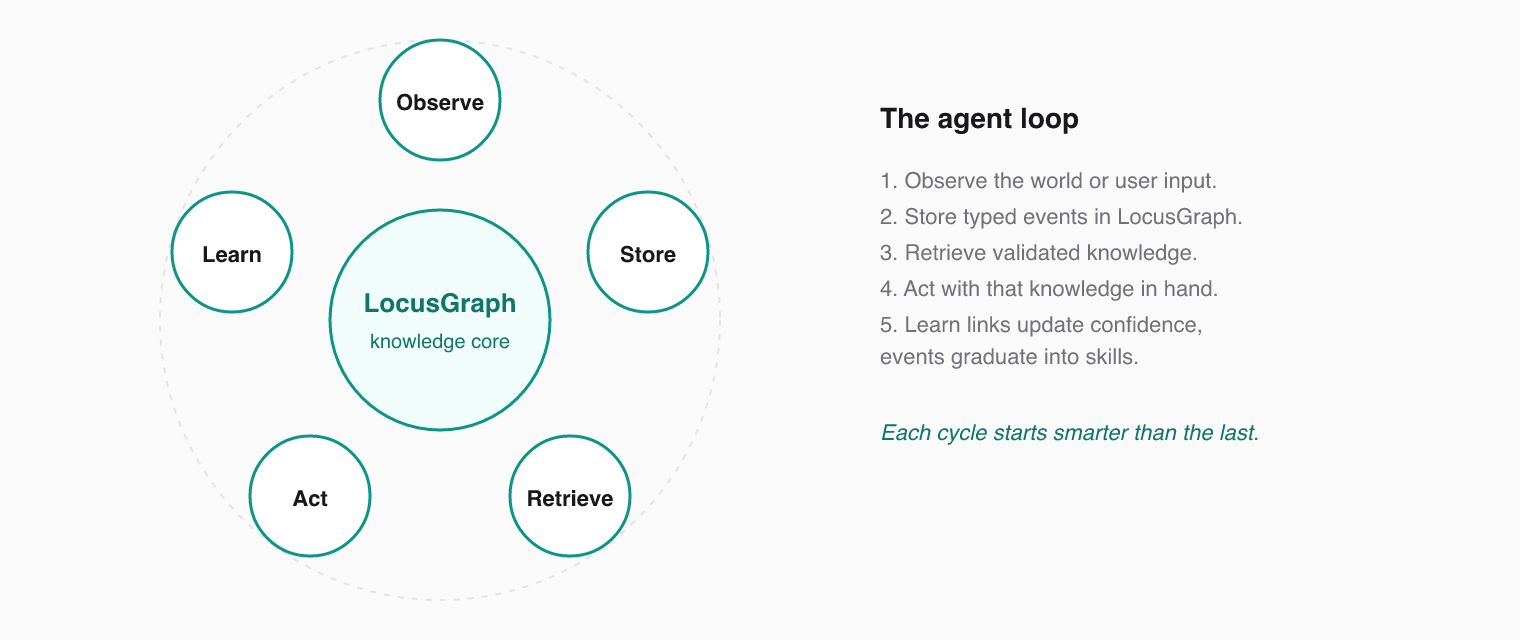
The Mechanism
When an agent makes the same mistake across sessions, LocusGraph preserves it as a mistake pattern. When the agent repeats a successful approach, LocusGraph reinforces it. When that approach keeps working, it graduates into a reusable skill.
single correction -> repeated pattern -> durable skillThe next time the agent faces a similar task, it retrieves the skill instead of rebuilding the same reasoning from scratch. That is what "starts smarter every session" actually means in practice.
The Loop, Concretely
- Observe the world or user input.
- Store typed events in LocusGraph.
- Retrieve validated knowledge before acting.
- Act with that knowledge in hand.
- Learn — links update confidence, events graduate into skills.
Run that loop every session. The graph compounds.
What Counts as a "Skill"
A skill in LocusGraph is just a context like skill:<name> that holds a graduated learning. It typically:
- references the patterns it generalizes (
extendslinks) - carries higher confidence than raw events
- gets surfaced first by retrieval when the agent queries the relevant area
Skills are not magic — they are graph nodes that earned their position through reinforcement.
Example: A Coding Agent's Skill Evolution
| Session | What happens | What gets stored |
|---|---|---|
| 1 | Agent writes off-by-one bug in pagination | observation under error:off_by_one |
| 2 | Same bug recurs | second observation, with reinforces to the first |
| 3 | Same bug a third time | fact under pattern:pagination_bounds, reinforces the error context |
| 4–5 | Pattern works to prevent the bug | additional reinforces links |
| 6 | Pattern proven | decision under skill:safe_pagination, extends the pattern |
By session 7, retrieving on "pagination" surfaces the skill — not a wall of error reports.
Skills are how token usage stays small as the agent gets wiser. The agent retrieves one validated skill: node instead of replaying the history of mistakes that produced it.