
2. What is Agent Structured Knowledge?
Agent Structured Knowledge is the durable layer of what an agent has learned from work it has actually performed. It is not a transcript, scratchpad, or pile of embeddings. It is knowledge with shape.
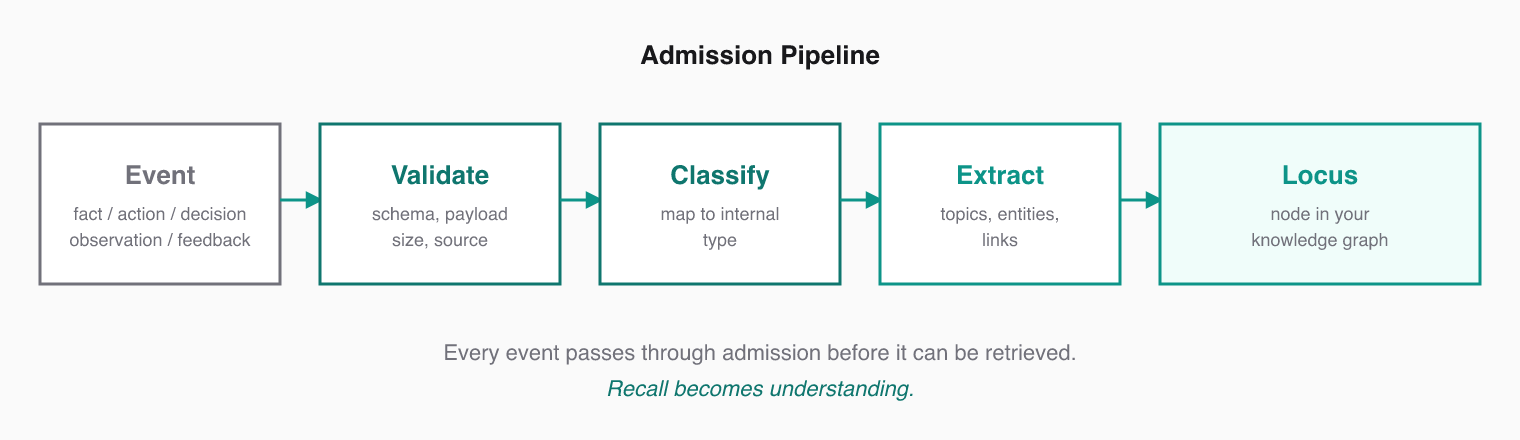
The Anatomy of a Learning
Every event admitted into LocusGraph carries:
- the event kind, such as
decision,observation, orfeedback - the source, such as
agent,user,system,validator, orexecutor - the payload that captures the actual learning
- the context that scopes where the knowledge applies
- the links to knowledge it reinforces, contradicts, extends, or relates to
- the confidence score that changes as evidence accumulates
That shape is what lets the agent retrieve validated knowledge, not just similar text.
Why "Structured" Matters
A plain memory system stores text and retrieves text that looks similar. Agent Structured Knowledge does more:
| Concern | Plain memory | Agent Structured Knowledge |
|---|---|---|
| Format | Free text or embeddings | Typed events with payload, source, links |
| Decay | Stale items stay forever | Contradictions lower confidence; bad knowledge fades |
| Reuse | Re-explained every session | Compounds across sessions |
| Trust | All snippets equal | User and validator sources weight higher |
| Output | Similar snippets | Validated knowledge for the current task |
The Knowledge Compounds
Repeating an experience does not bloat the graph — it strengthens it. Two events linked with reinforces carry more confidence than either alone. A new event that contradicts an old one quietly demotes the old one in retrieval. This is how memory becomes knowledge.
Agent Structured Knowledge is what graduates. A single event is data. A reinforced cluster is a pattern. A repeatedly validated pattern is a skill.