
3. The Graduation Plane
The core differentiator in LocusGraph is graduation. Events do not just get stored — they get admitted, linked, scored, and promoted up a four-stage plane.
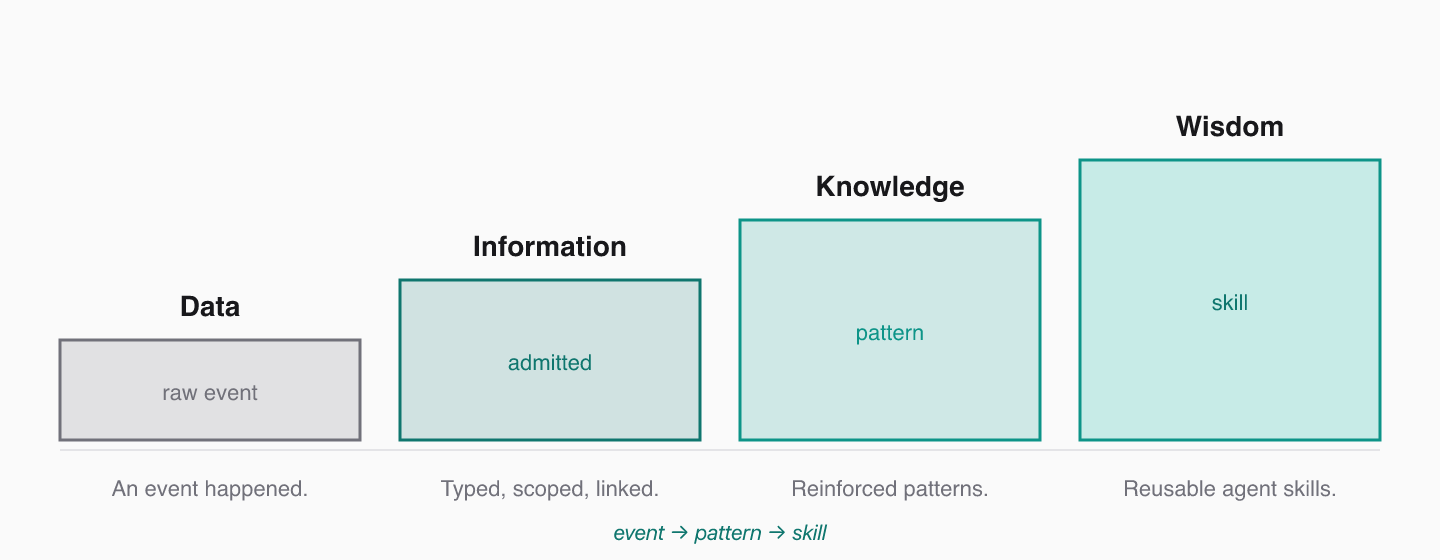
The Four Stages
| Stage | What it means in LocusGraph |
|---|---|
| Data | A raw event happened: an error, action, decision, observation, or user correction. |
| Information | The event is admitted, typed, scoped, and connected to a context. |
| Knowledge | Repeated evidence turns isolated events into patterns with rising confidence. |
| Wisdom | Validated patterns graduate into skills the agent can reuse in future work. |
The compact version:
event -> pattern -> skillHow Graduation Works
A fact reinforced five times rises in confidence. A fact contradicted drops. A repeated failure becomes a mistake to avoid. A repeated successful workflow graduates into a skill.
This is automatic. You do not have to manage it manually:
- Admit events with the right kind, source, and payload.
- Link new events to existing ones with
reinforces,contradicts,extends, orderived_from. - Confidence scoring updates the graph in place.
- Retrieval ranks well-validated knowledge to the front.
Patterns and skills are queryable as their own contexts (e.g. pattern:pagination_bounds, skill:safe_pagination), so the agent can ask for "the skill for X" instead of replaying the entire history of mistakes that led there.
The Plane in a Coding Agent
| Plane stage | Concrete example |
|---|---|
| Data | "Index out of bounds in pagination logic." |
| Information | Admitted as an observation under error:off_by_one. |
| Knowledge | After 3 hits, a fact under pattern:pagination_bounds reinforces the pattern. |
| Wisdom | After 5 successful uses, a decision under skill:safe_pagination extends the pattern. |
The graduation plane is what makes LocusGraph more than memory. Skills retrieved during future sessions prevent the same mistakes from recurring.