
7. Own Your IP as a Skill
The way your team solves problems is intellectual property. Your debugging habits, architectural preferences, review standards, deployment patterns, customer context, and hard-won corrections should not live only inside one model session.
What "Operational IP" Looks Like
Most engineering teams already have implicit IP that an LLM cannot guess:
- the conventions you actually use, not the ones in your README
- the bugs that keep recurring in this codebase, and the fixes that worked
- the architectural decisions you made and why
- customer-specific context that took months of meetings to learn
- the review standards that aren't written down anywhere
In a typical AI IDE workflow, that knowledge lives only inside the current chat. When the session ends, it's gone. When the model changes, it has to be re-explained from scratch.
How LocusGraph Captures It
As agents work with your codebase, customers, tools, and workflows, LocusGraph captures their experience as typed, linked, scored events. Repeated learnings graduate into skills, which become a layer of operational knowledge your team owns.
| What you stored | What it becomes |
|---|---|
| Recurring corrections during code review | skill:review_standards |
| Repeated architectural decisions | skill:architecture |
| Customer-specific quirks the agent rediscovers | skill:customer_<name> |
| Debugging steps that worked | skill:debug_<area> |
| Deployment patterns that succeeded | skill:deploy_<service> |
The skills are queryable, retrievable, and durable across model swaps, agent rewrites, and IDE changes.
Why This Matters as IP
| Property | Plain LLM workflow | LocusGraph |
|---|---|---|
| Survives model upgrade | No — context is in the prompt | Yes — knowledge lives outside the model |
| Survives agent rewrite | No | Yes |
| Survives IDE switch | No | Yes — same graph reachable over MCP |
| Owned by | Your prompt history | Your team |
| Compounds | No | Yes |
The result is not just an agent that remembers more. It is an agent that carries your team's accumulated judgment into future work.
Practical Setup
A typical team layout:
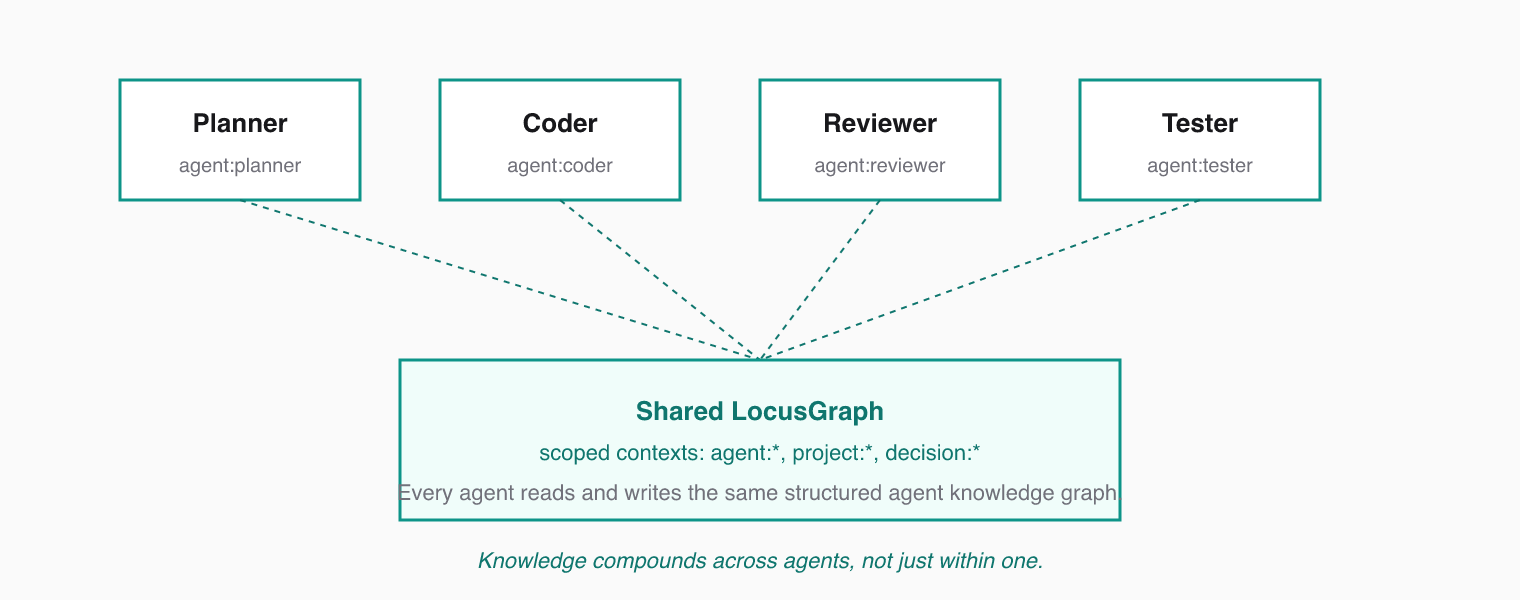
- One graph per project for isolation.
- Multi-agent contexts (
agent:planner,agent:coder,agent:reviewer) so each role's contributions are traceable. - Skill contexts (
skill:*) for graduated learnings. - Customer / project contexts (
project:*,customer:*) for domain-specific knowledge.
Every agent your team runs reads and writes the same graph. The IP compounds.